Showing posts with label conservation. Show all posts

Saturday, July 14, 2018

Coccolithophores Impressed: Ōku Moana and The Sandpit Collective


 Coccolithophores are a group of microscopic phytoplankton found living in earth's sunlit oceans. These single-celled algae are surrounded by armoured plates ('coccoliths') made from calcium carbonate (limestone). They are vulnerable to ocean acidification; coccolithophores will be threatened in future ocean phytoplankton communities, with potentially dramatic consequences for the global carbon cycle.

Scanning electron microscopy image (x17.000 magnification) of
the cosmopolitan coccolithophore Emiliania huxleyi  (Ro Allen)

 During New Zealand International Science Festival (6 – 15 July) The Sandpit Collective (Dr Jenny Rock and Lynn Taylor) combined with Ro Allen, a candidate in Science Communication at the University of Otago whose PhD research focuses on coccolithophores.   

To share concern regarding the projected increase in ocean acidity due to climate change and to highlight the significant challenges for coccolithophores we designed a SciArt experience as part of the Ōku Moana exhibition at the Community Gallery in Dunedin.

The Sandpit Collective believe that engaging people in art and aesthetics can be a way to raise awareness and share scientific knowledge.  


Under 12's worked on texture rubbings of healthy and unhealthy coccoliths. After revealing various stages of disorganisintion in coccolith formation due to the effects of ocean acidification they cut out and attached their rubbings to the corresponding giant healthy and unhealthy coccolithophore models. 

Texture Rubbing table with laser cut coccoliths


Close up of texture rubbing healthy coccoliths

Healthy coccolithophore model with it's
armour on: texture rubbings of liths
 by exhibition visitors
Coccolith necklaces worn by
The Sandpit
facilitators
Participants could also make their
own 'microscope slide' of
 rubbings and drawings

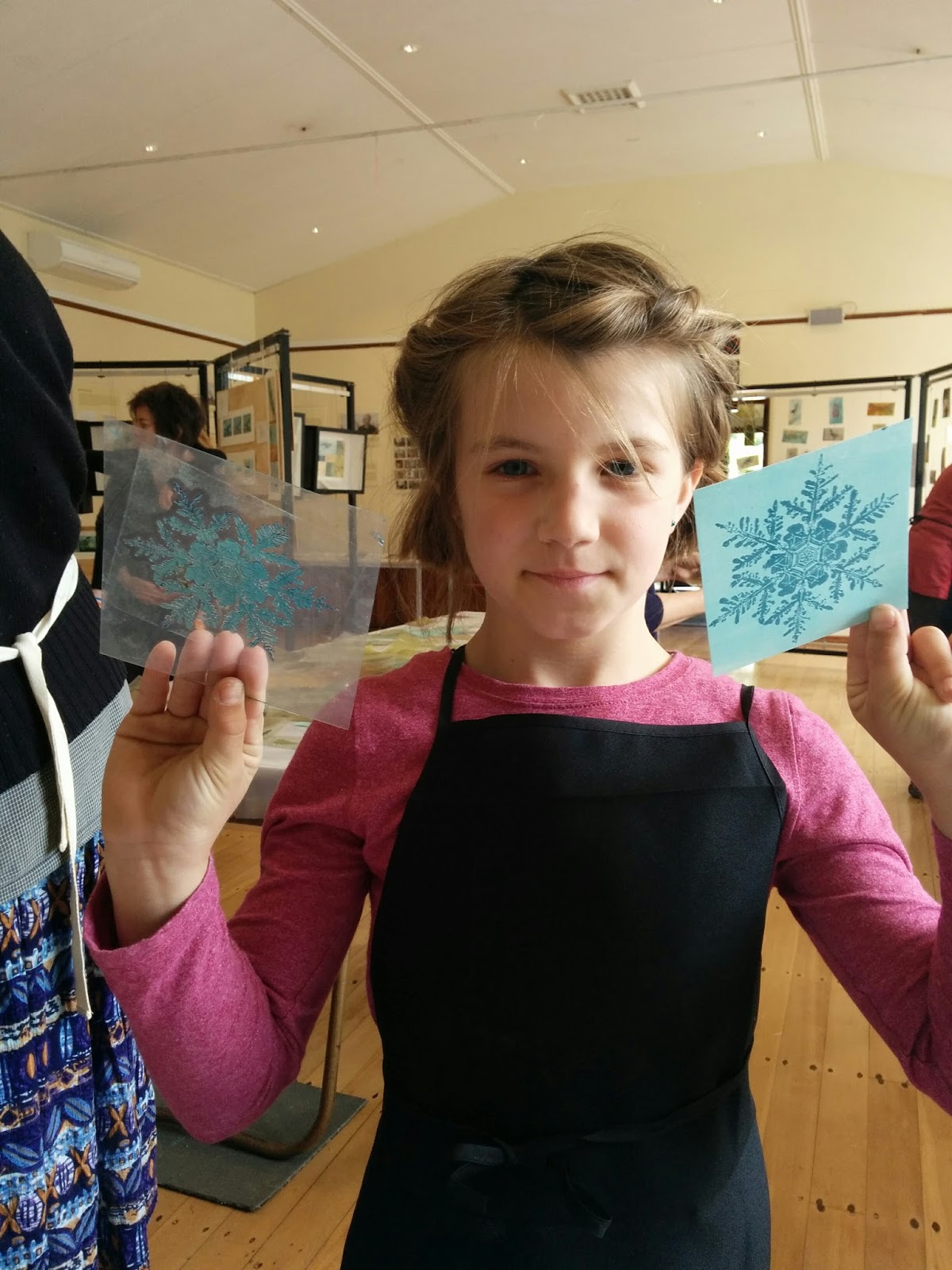
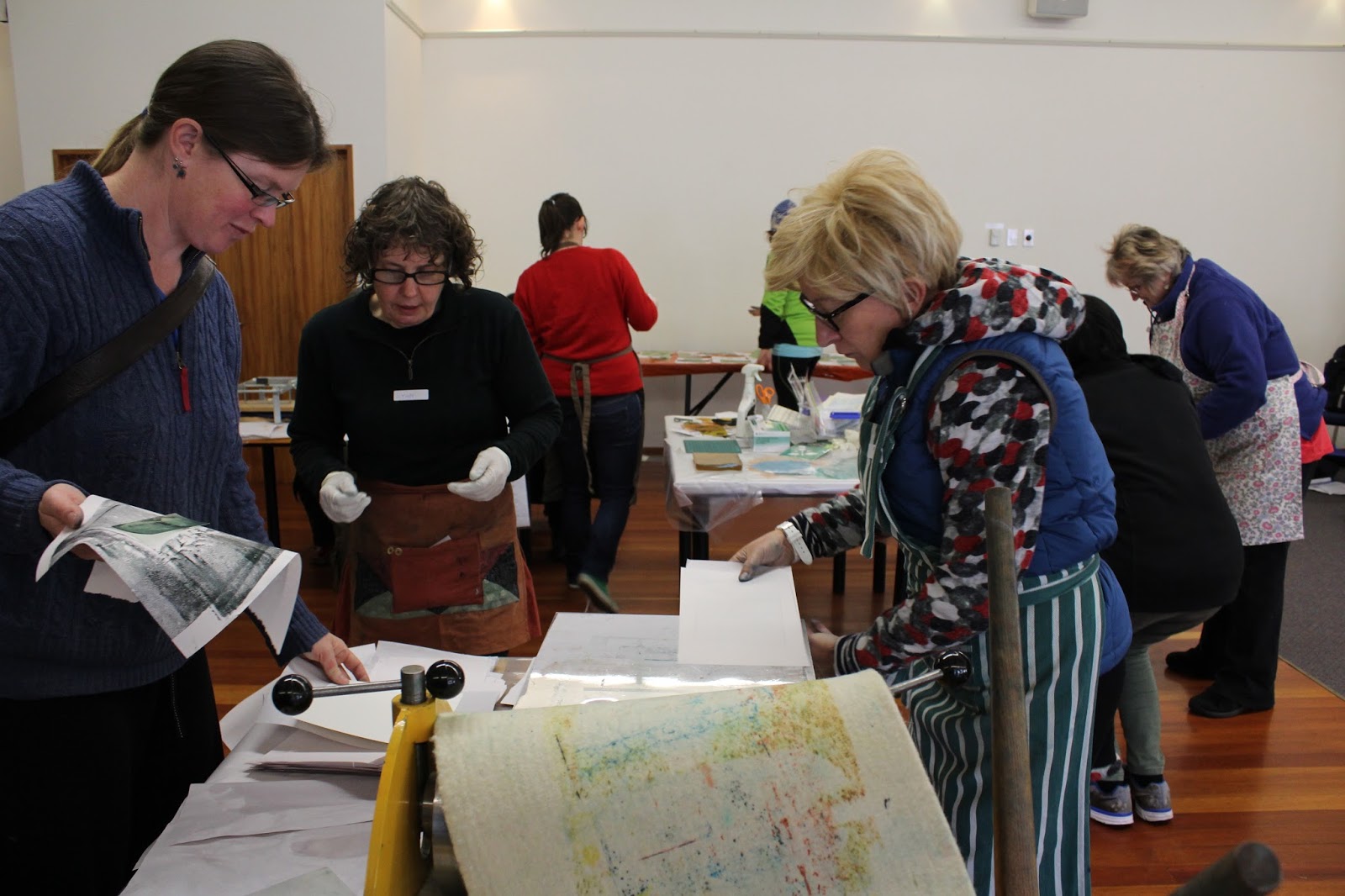
 Visitors aged 12+ (and for the occasional younger person who persuaded us) were invited to make their own blind emboss prints of healthy and unhealthy coccoliths. Working around a press is  a communal activity and provided a great opportunity to discuss the role and importance of coccolithophores in trapping our carbon emissions.

Bella and Emma working at the printing press 

Prints were taken away in an information pamphlet that Ro published so people could follow up on scientific specifics after the experiences.

Pamphlet which provided protection and information to go
 with the prints


Alongside participants making emboss prints to take home most contributed a print to the community art work which built up over the course of the exhibition. We had over 100 participants with in excess of 400 blind emboss prints made.  Thank you to everyone who participated and helpers: Pam, Jesse,Trevor, Sara, Becky, James and Scarlet to name a few. 

Installing emboss prints on the community exhibit.
 Unhealthy on the left, healthy on the right.
 (Not applicable to the participants!)


Laid out in a grid the prints become like a survival blanket - a way of visibly seeing the importance of this phytoplankton that is too small to see with the naked eye. 


A selection of blind emboss prints 
created by Ōku Moana visitors


The paper we used was off cuts from a business associated with the University of OtagoThe prints, when stacked resemble the sea and ocean floor which lead to the inspiration to photograph the prints back in the habitat of the coccolithophore, the sea.


Stack of prints showing deckled edges of the paper

It's the middle of winter in Dunedin, in fact the exhibition was aligned with Matariki celebrations and my feet went numb in the sea whilst retrieving the prints. 

Coccolith prints thinking about home

Releasing coccolith prints back to the sea under 
the watchful eyes of seagulls
In a poetic happenstance prints that tumbled back to shore with the waves were added to with a layer of sand. Beautiful incidental drawing that felt like an appropriate closure to a week of appreciating our oceans.

Sea and Sand drawings
Interested groups are welcome to use these texture rubbing and solar plates as a starter kit for their own SciArt activity if you contact us and organise courier of the items. 
Other items of interest at: https://www.facebook.com/events/2034430683438301/

Saturday, November 19, 2016

SciArt: Orokonui Halo Project with The Sandpit Collective

Some photos of process  - using art as a platform to encourage awareness and conversations around biodiversity and predator control.
HALO Project http://www.beyondorokonui.org.nz/news/92814fe6-042d-463f-be52-ef8c34ede15a


Monday, February 29, 2016

Images from Postcards to the Peninsula + Our Island


All welcome! Citizen Sci Art.
Our Island - the travelling show-
 art work by Stewart Islanders 


'Our Island' art work was very much admired.


Frottage, rubbing over printing plates

Drawing thaumatrope imagery
 - guided by team member Ali Rogers
.
                    Thaumatrope making


Thaumatrope making on the stage and postcard printing
going down alongside the Stewart Islanders Exhibition

Anticipation at the press bed.

Postcards were curated to chew card size.
Love how this print mimics her top and she did too.


A fantastic response from the community.
 Assisted here by The Sandpit Collective innovator and
team member Jenny Rock.


Cathy sharing info on rats and possums at the
Otago Peninsula Biodiversity Group 'pledge' table.

Participants printed two postcards -
one to keep and one for a communal art work.
 Assisted here by team member Ellen Sima.
Making a pledge - recorded on the back of the prints


Reading messages and pledges

At the end of day one.


Tuesday, October 20, 2015

Stewart Island Rakiura Community Conservation Art. SIRCCA

In mid September Jenny Rock and I went to Stewart Island to facilitate a printmaking workshop and exhibition along with assistants Elsie Percival, Ellen Sima and Lydia McLean. We advertised a ‘Printmaking Workshop with an Island Conservation Twist’ in the Stewart Island News, outlining the workshop goals and theme.  Basically, a weekend ‘drop – in’ printmaking workshop, which was offered to locals and visitors, that was to be subsequently exhibited in the Community Hall the following weekend. Attendance was free and people could elect how they stayed and participated. Inclusion was a goal but our team did experience a bit of teeth gnashing. Would anyone come along? Or would we get too many people and not have enough materials? How long would people stay?  This unorthodox approach was a deliberate trial to begin exploring how printmaking could create a platform to encourage community issues to be expressed in new ways.
A ‘drop-in-do -a-print’ scenario may not sound unorthodox but our workshop had a specific conservation and biodiversity focus linked with a major local (and national) controversy about methods of predator-control.  The art work being produced needed to link with content and concept, not just look ‘good’. We resourced some relevant, specific imagery by a variety of means including photographing moths, bones, native birds and eggs from the collection at the Otago Museum, downloading PDF's with images of animal tracks recorded on tunnel papers, gathering poison information sheets (eg. Brodifacoum), looking at SIRCET's website and did a lot of internet searching in general.

Source photograph          -          manipulated into black and white           -          inverted to create a negative
 Some of this imagery went on a resource table for inspiration and reference and some was translated into digital negatives suitable for make relief solar printmaking plates. High contrast black and white is needed to produce a relief plate and so I manipulated images in Photoshop as much as I could before printing them out. A challenge was that a lot of the available imagery was in a low resolution, so  while this is ok for online viewing the definition may be lost and edges are pixelated or jagged. With the example above of the Chewed Pate I had to draw into the printed out negative with black pen before printing the negative onto transparency at Uni Print.  (The toner needs to be dense enough to block the light and so it is best to use a quality commercial printer.)


Some pre-prepared solar plates.
Esther, a visitor to Stewart Island choosing which plates to print
 Participants began by printing mono prints to get the feel of the rollers, ink and press and to create  backgrounds suggestive of sea, sky and landscapes. We set up a Gelatine printing table as an alternative medium and as a space for people to try organic printmaking.  Gelli print is quick and  capable of producing abstract backgrounds and detailed surface prints directly from flat materials.

Jenny assisting with Gelatine Printing

Participants added to their backgrounds, building up narratives by relief and intaglio printing multiples. Some made their own solar plates and others carved woodblock  plates. 

Iris with a mono printed background. 
Ellen preparing a relief plate.  
I am always going to be biased about printmaking, always top of the list for me partially because printmaking exists in a community. Print shops grew out of a need to share equipment and technical knowledge as well as to have a creative environment to work in, where work can be discussed and ideas can be exchanged. However, we asked ourselves if print was the best medium. Setting up a print workshop takes a lot of time, money and equipment. Hence it is largely not taught in our school systems but perhaps this is an advantage, most people came to the workshop with little or no experience which is nicely democratic. 

A snippet from the two day printmaking frenzy
Our team went in with the teaching philosophy that there were multiple right ways of making the prints, no wrong answers. Brief instructions were given on rolling the ink and intaglio wiping but I witnessed that a lack of burgeoning rules and printmaking knowledge encouraged diverse creativity and experimentation and production was very high.
Molly is a natural printmaker 
Making or selecting your own printing plates followed by printing images and words becomes an act of self- publishing which strongly enables people articulating their own opinion. The ‘multiple right ways, no wrong answers’ philosophy flowed into the conceptual responses of the participants and resulted in some works being ambiguous or titled as questions.
Elsie assisting Di print directly from a salmon farm net
Removing the inked up net
We primarily printed edge to edge, bleed prints on small pieces of paper. Therefore multiples could be made and if something did not ‘work’ or ‘fit’ it was only a small loss. People were extremely productive - Stewart Islanders have stamina and their bond with their natural environment is very evident .
At the press bed with Gill working on the Gelatine Print table in the background
Starting to realise how big a task mounting all the works would be!
Over the week I worked as an artistic editor, collating together people’s small individual prints onto larger pieces of paper to create a final artwork. People had varying degrees of input to the arrangement of their collated print and in most cases I added block of plain colour (a rest spot for the eye) something that we did not have time to print on the workshop. A small selection of some of the artworks.....
Sandra

Letitia

Lydia

Lydia McLean and Tom Csima (who came down at the end of the week) curated the ‘locals’ exhibition on the basis of colour and the grid like layout echoed the tile composition of the prints themselves. The exhibition had a huge number of enthusiastic attendees, many of whom came back multiple times, people wanted to see what each other had made and thought (Participants wrote an artist statement which accompanied their work). It was in this exhibition space that the platform for discussion really happened and workshop participants also commented that they felt a heightened awareness of ecological issues since the printmaking.


Megan

 What is next? The SIRCCA prints will go north to Beyond Orokonui and be represented in a series of exhibitions in conjunction with The Sandpit, after which work will be returned to the makers. There were many useful outcomes from this trial which will be utilised in future workshop/exhibition combos. Ideally a longer residential workshop would be ideal. There is lots to think about, such as of making some information and technical videos.

Nic

Pip

In future maybe participants could make two similar prints – one to keep and one to exhibit or possibly there could be an exchange with another community. For this workshop we did not want the restriction of editioning but if there was longer workshop participants could trial some prints and then produce a small edition or series.

Di
Working in the eco art realm means attention must be paid to materials. We worked with solar plates, gelatine printing and oil instead of solvents. We asked participants to bring ferns, feathers and leaves which printed effectively.  Two participants, Nic and Di, came to look at the workshop then walked along the beach and collected rubbish. They subsequently printed their finds and made us all swoon in admiration. Next time we could include more collecting of samples and materials from the local area and items could also go to create a specific children’s printmaking table with stamps made from corks and bottle caps etc. More focus needs to go onto nontoxic printing inks. There are Akua soy based inks but these not quite stiff enough for holding clarity in relief plates. I read someone was printing with soil, this makes me wonder what else we could be printing with.
Sue
 Our team of artists and scientists worked quickly to absorb as much as we could about each other’s fields while making some lovely relationships with members of the Rakiura/ Stewart Island community. (We even fitted in some recreation - thanks to Megan for swift tours of the Island and Ulva for a tour of Ulva Island. There was also the Boot Camp experience.) We all want to return! I loved that printmaking and art felt so purposeful.  This venture had the support of many people and companies but I would like to give special mention to SIRCET, the Stewart Island Rakiura Community & Environment Trust, for their contribution.  SIRCET's mission is to "pursue projects that will enhance both our community and environment". sircet.org.nz/

Shona
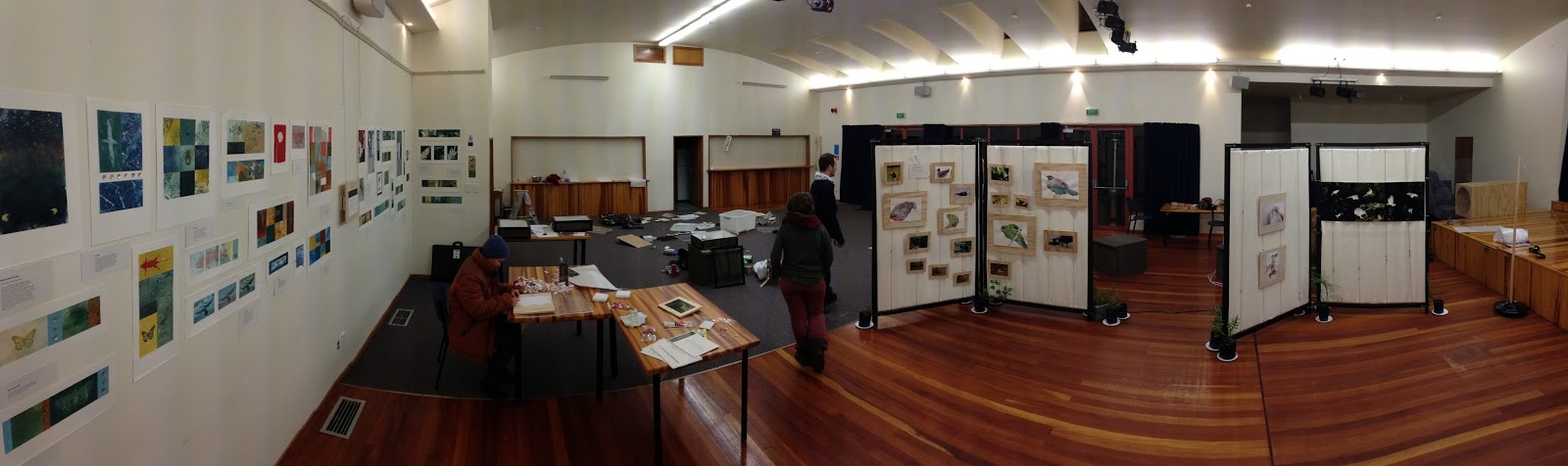
Elsie Percival,one of the workshop facilitators is also a Science Communication Master’s candidate from Otago University. Elsie presented her own project ‘Our Island- Conservation on Rakiura’ on Stewart Island in a parallel exhibition at the Community Hall the same weekend. Her Rakiura/Stewart Island specific art work and photographs were displayed alongside plants from the Community Native Plant Nursery (SIRCET) and trapping equipment from DOC. The photo below shows some of the portable exhibition kit, named The Sandpit, that the variety of her work was curated within. Elsie’s thesis and other in-depth writing on the ‘Our Island’ project is planned so I will link that to here when she publishes her blog.
SIRCCA & Our Island. Photo credit to Elsie Percival.